
2026.08.10
On July 18, 2026, the body of 38-year-old Scottish woman Elisabeth-Jane Ross was found inside a suitcase in an abandoned building in Kypseli. The woman had arrived in Greece a few weeks earlier and had gone missing on July 15. The case quickly gained international attention and led to the arrest of a 26-year-old Afghan man, who faces charges of homicide and robbery. He denies killing her, although he admits to transporting her body.
Up to this point, it is a horrific crime. However, the case takes on an even more paradoxical dimension when one examines the past of the accused—a man who had been presented internationally as a role model for the successful integration of an unaccompanied Afghan refugee, had become the subject of humanitarian narratives, and had turned his personal story into a video and an autobiographical book.
A story presented as “from hell to home” is today at the center of a case that is anything but similar to the narrative previously built around his person.
The man who is now accused of the murder of a woman had previously been portrayed as an example of the successful integration of an unaccompanied Afghan refugee and as someone who helped other refugees.
Ahmadzai arrived in Lesvos in 2016, at the age of around 16, following a very difficult journey from Afghanistan via Pakistan, Iran, and Turkey. According to the subsequent narrative attributed to him, he traveled for about 45 days and tried three times to cross from Turkey to Greece, with the first two boats sinking.
In Moria, he worked as a translator for a humanitarian organization, learned English, and then settled in Athens. He later became a boxer and, together with his wife Alaina, created the initiative Love Every Nation Athens, focusing on supporting migrants and particularly unaccompanied minors. This is also confirmed by the organization’s own website.

The same website characteristically mentions that Sharif had a special interest in “unaccompanied minor boys” because he himself knew what they were going through.
His story received global exposure. It served as the example of a successful integration of a migrant into a European state.
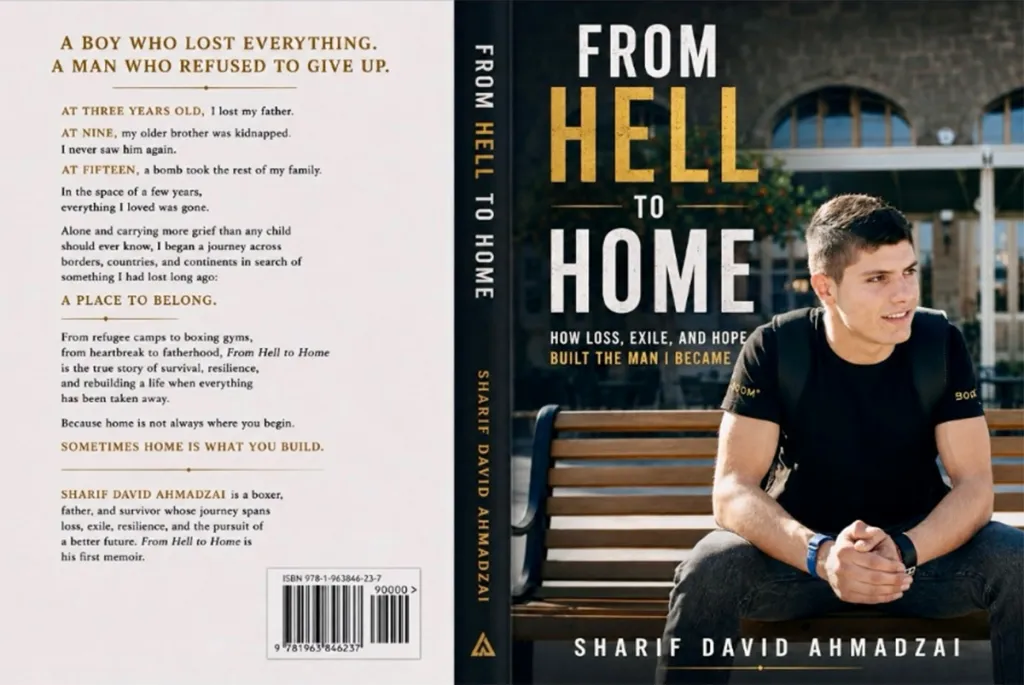
Front Cover
FROM HELL TO HOME
HOW LOSS, EXILE, AND HOPE BUILT THE MAN I BECAME
SHARIF DAVID AHMADZAI
Spine
FROM HELL TO HOME
SHARIF DAVID AHMADZAI
Back Cover
A BOY WHO LOST EVERYTHING.
A MAN WHO REFUSED TO GIVE UP.
AT THREE YEARS OLD, I lost my father.
AT NINE, my older brother was kidnapped. I never saw him again.
AT FIFTEEN, a bomb took the rest of my family.
In the space of a few years, everything I loved was gone.
Alone and carrying more grief than any child should ever know, I began a journey across borders, countries, and continents in search of something I had lost long ago:
A PLACE TO BELONG.
From refugee camps to boxing gyms, from heartbreak to fatherhood, From Hell to Home is the true story of survival, resilience, and rebuilding a life when everything has been taken away.
Because home is not always where you begin.
SOMETIMES HOME IS WHAT YOU BUILD.
SHARIF DAVID AHMADZAI is a boxer, father, and survivor whose journey spans loss, exile, resilience, and the pursuit of a better future. From Hell to Home is his first memoir.
“The above book was likely never published, as ISBN 978-1-963846-23-9 could not be found in the catalogs. Nor can we verify whether the story told to us by SHARIF DAVID AHMADZAI is true. However, British reports (Daily Telegraph and other media) state that the Red Cross had created a film/video about Ahmadzai’s story and that the material was removed following his arrest.
It is worth asking, therefore, with what eagerness the “system” seeks out and promotes moving stories of “successful integration”—such as the persecuted refugee who, despite adversity, becomes the role model of a person who “made it” in the host country. When, however, reality refutes such a narrative, that same eagerness vanishes, and the difficult questions remain unanswered. This specific case—much like others before it—does not prove that every migrant fails to integrate. It does prove something far more essential, however: that integration is not a given, is not achieved through PR narratives, and cannot be judged by moving stories constructed in advance as ‘success stories.’ True social integration requires time, reciprocity, rules, scrutiny, and—above all—evaluation of results, not the idealization of intentions.
Because a society that fears asking hard questions and prefers emotional stories over reality ultimately risks becoming a hostage to the very narratives it constructed itself.”