The Book of Slavery
- 2026.06.27
- George Andeou
In posts related to the extermination of the Christian populations of Asia Minor, references are made to the Death Marches and the Labor Battalions. However, words are often poor and helpless in describing the horrifying reality.
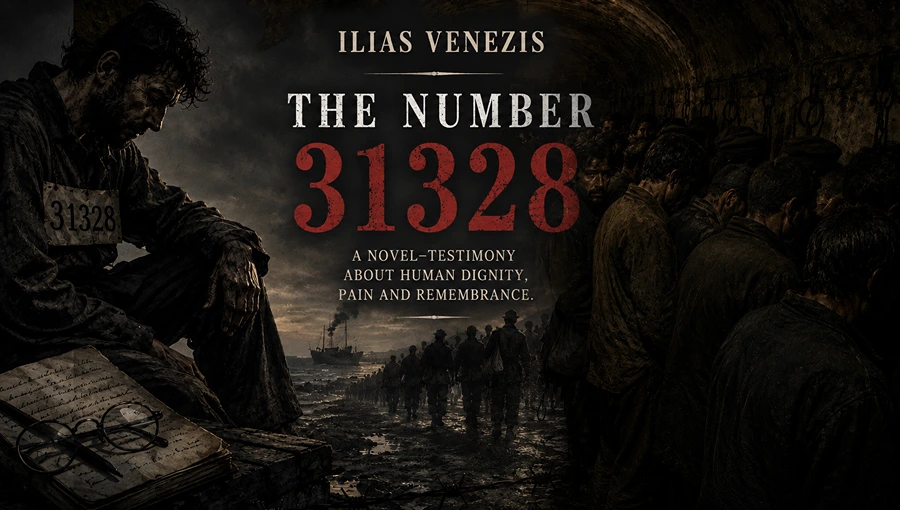
The subject of this book is precisely the marches of men and women into the interior of Turkey, and life in the labor battalions (the notorious “Amele Taburu”). These were organized by the Turks using conscripts of foreign nationalities when the first persecutions began after 1914, and in them thousands of people martyred in 1922, especially after the collapse of the front and the retreat of the Greek army.

Elias Venezis (1904-1973) was “conscripted” into these labor battalions and is among the very few who managed to survive. Under wretched living conditions that decimated the impoverished crowd of slaves and prisoners—with the torment of thirst and hunger always present, epidemics reaping lives, endless exhausting marches, rapes, and every type of atrocity—the conscripts broke stones, cleared roads, and repaired bridges, all under the clear intent of the Turks to take revenge upon them.
In this sad and dying procession, which was constantly on the move, the individual ceased to have a personality; they became a number without a past, without a history, and without a future. They were transformed into a plaything in the hands of their opponents, an existence without any value whatsoever, amidst the horror, absurdity, and madness of war. The ingenuity displayed in methods of torture by victors throughout the ages toward the defeated is not the unique privilege of any single nation. Nor can there be a gradation in atrocities and the multifaceted expression of vengeance and hatred when human passions are unleashed.
Below are a few excerpts from the 47th Edition of the Book. ESTIA BOOKSTORE – I. D. KOLLAROU & CO. S.A.
Selection for Execution
Note: Periodically, a so-called “skimming” (skimming off the top) takes place. The Turks select a few individuals from the groups of prisoners, separate them from the others, and execute them through various means.
… The first officer approaches. It is the very same one who beat us this morning. The officer looks around by the light and drags one of our men out of the line, to the side. He looks at him, laughs, then moves further along. He drags another one out.
— “You too, dog!” he says.
Another one. The light, held by the soldier with the lamp, draws closer and closer to where we are. This light shines as if it has a terrible obligation—just so, as it must. For a brief split second, I wonder if he is choosing young or old. But I see he takes them randomly, of all kinds. Meanwhile, the light has arrived. It is right in front of me. I feel my young years completely exposed, chest to chest like this. My breath catches. The officer’s hand reaches out to drag me away.
But at that exact moment, a trivial moment, tick, the officer stumbles from the alcohol. He laughs. He makes an effort to regain his balance, but with this movement, his position shifts by two inches. Two trivial inches. His hand falls straight onto the captain next to me.
I breathe a deep sigh of relief. Ah, deep down inside, there is a harsh joy, such a harsh joy…
The Priests
Note: In this harrowing excerpt from Elias Venezis’ “Number 31328,” the arrival of a group of elderly priests from Ayvali at a detention site for Greek prisoners during the Asia Minor Catastrophe is described. Subsequently, through the “skimmings,” they are all exterminated.
… Near noon, we heard a loud roar. The door of the warehouse opened, and the new batch poured inside, shouting. At first we were frightened, trying to guess what these figures could be. Then, filled with awe, we recognized them.
— “My goodness! Look!”
It was a dense mass of bellies appearing first, some bare to the elements, others hidden behind long linen undergarments that were fraying at their mud-covered legs. Then came the heads—eyes, braids, beards—all tangled up like a ball of yarn, as if they were returning from a massive brawl.
— “My goodness, it’s our priests!”
There were about thirty of them, all the elders of Ayvali. On only a few did any remnants of cassocks still wave. One or two still kept their clerical caps, crooked and crushed from the beatings. The others were stripped bare, left only in their undershirts and undergarments. They threw themselves to the ground, crying out together from the pain. Then, driven by hunger, they rushed toward the salted food. They grabbed the sardines and swallowed them whole, scales and all, drinking buckets of water, again and again.
Only two, just as they fell, did not move at all—a young, gentle, frail figure, and an elder over seventy years old. They were groaning. The priests had made the same journey as us, just a day later. We asked them for news. They didn’t have time to tell us. The detachment arrived. They ordered us to hit the road. We had recovered slightly from the night’s sleep and the bread. But the clergymen were a pitiful sight. Above all, those two refused to stand up. They forced them.
We set out on the road. To the left gleamed the Acropolis of Pergamon—Attalus III, having separated from his consort… The procession stopped. Commotion. The soldiers were cursing and shouting. The old priest refused to go any further. He collapsed.
— “Two of you grab him by the arms!” the commander orders.
Two of us grabbed him by the armpits and we moved forward. But his legs wouldn’t follow; they dragged along the ground. We stopped again. The sergeant, furious, comes from behind. With the muzzle of his rifle, he delivers one, two, three blows to his waist to revive him. He slipped from our hands, grew heavy, and fell.
The soldiers, seeing it was no use, dragged him to the side of the road, left him face down, and began delivering consecutive blows with their rifle butts. He didn’t even groan. Only his tongue licked the earth—as if to taste it: is it tart, is it bitter?
The March
… The new guard post that took custody of us consisted of horsemen. They had a brilliant idea: we left the straight road and headed into the fields. This was a merciless ordeal for our bare, blistered feet. The clods of soil were dry and hardened by the sun. It hadn’t rained yet. We tried to avoid them, because you cannot maintain your balance barefoot on them. But we fell into another blessing: old thorns that drove us mad.
— “I can’t! I can’t anymore!” everyone cried out.
And yet, we all ran so as not to be left behind. We trembled with the fear that whoever was left last would be killed. One hurried to overtake the other, and the next—a mad competition that was choked inside our groans. On the fly, we would yank the thorns out of our soles and keep running. The soldiers chased behind us on their horses, striking us with their rifle butts so we wouldn’t stop. We were like a herd of ragged, wild-haired beasts—running across the plain to find shelter somewhere because they smelled the storm coming.
The Rapes
Note: The rapes of both men and women were frequent. Venezis describes the rapes of women at various points throughout the book. The imagery is shocking.
… Night fell upon us in Agiasmat. They took us to a dark, low-ceilinged building. As soon as we stepped inside, we were struck by a smell of manure, sulfur, and holiness. We understood that this was a house of the Almighty, now serving as a stable or a storehouse. A dead silence reigned. With our cupped hands, we poured out the noise coming from our bitter mouths. Then we lay down upon the flagstones, just as each of us happened to land. Argyris was near me. Deep in the back, toward the Sanctuary, the family went. I could tell by the little child crying. It must be afraid of the deep darkness…
Note: Three Turkish soldiers enter the church holding a candle, searching for a woman to satisfy their desires.
… The candle reached its destination, the Sanctuary. We hear a piercing woman’s shriek spring up from back there, in the depths, slapping the bitter air for a swift minute. Then another shriek. But this one dies out abruptly, cut off by a hand that plugged the screaming mouth. The soldiers, it seems, were anxious not to make noise. The comrades stand up silently, with caution, and move toward the Sanctuary to see. I stand up too and go close, wall by wall, hidden in the half-darkness. The woman was holding onto her husband with both hands and refused to let go. The little child is lying between them. It hasn’t woken up yet. A curl full of dust has stuck to its forehead, falling right there, next to the lowered eyelid. It is so peaceful—a curl. It must have been dreaming.
The soldier pulled at the woman, gently at first; he wanted to be polite. But the pulling grew stronger and stronger, continuously. He was growing impatient. His eyes were strained with desire and, as the woman’s resistance continued, a quick flash rushed into them and smeared them with light.
— “Save me!… Save me!…”
The husband hears his wife. He has a lost look, the words are tied up inside his mouth, howling to get out. They wouldn’t come out.
— “And why don’t you kill me!” the woman screamed at him with desperate rage. “Why don’t you kill me!…”
Moved, lost, he finally manages to supplicate the soldiers:
— “Have mercy on us!… Have mercy on us!…”
He raised himself slightly forward, making an effort to hold this posture of an awkward kneeling. A kick to the ribs. His large frame fell abruptly backward. And the woman lost her grip on him. She tried to catch hold of something, and grabbed the child’s little leg. And the child, waking up, shrieked along with her:
— “Mother!… Mother!…”
For a short distance, they dragged her. She dragged the child along with her too. Then she let it go. They came out of the Sanctuary. They stopped near the entrance, behind a column. One of them took a wide wooden plank that was by the door and leaned it against the column, to screen off the area so we wouldn’t see. But for this purpose, the plank was small, shorter than a man’s height. Only a few things were hidden.
— “In here!… Right before our eyes!…” someone murmurs in horror. “The dogs!”
— “Shh!” says someone else.
Hidden in the darkness, we had glued our eyes there. Our hearts were pounding. We watched with an relentless curiosity, like a madness, lest we miss even the slightest detail. One soldier was struggling to throw the woman flat on her back onto the ground. She wouldn’t fall. Then the two caught her by the hands and the third by the legs. They had cast politeness aside now. Their hands, their bodies worked with fast, nervous movements; they could endure it no longer. They laid her flat on her back. The middle soldier was in a hurry to free her from a couple of garments. The others held her with her hands pinned against her chest. For one last time, she struggled to gather her strength, to resist. She broke free, twisting like a snake, howling:
— “Kill me! Kill me!”
They brought her back to the same position, flat on her back, with the three pairs of hands pinned upon her. Having nothing else left to do, she began to strike her head repeatedly, desperately, against the flagstones. The dull thud strove to maintain itself for a moment amidst her screams, which were growing weaker and weaker. Finally, she calmed completely. You could only hear a low, tearful murmuring, a lament. And very sparsely, a final head-strike or two against the flagstones—like belated applause amidst the panting breath of the beast above her, which was “expressing itself.”
I turned my eyes away. Two or three comrades had gathered close together, standing upright, forming a screen around her husband so he wouldn’t see. He had huddled there, ragged, half-naked, crushed, bending over his little child with the curls who was whimpering, holding it tight.
— “How will I bear it?… How will I bear it?…” he murmured through his tears. One of our men tried to quiet him.
— “Comrade, it is no shame. All of us, one day, can attest to how impossible it was for you to do anything…” The low wailing kept coming weaker and weaker from that other poor, half-fainting creature over there. It passed through the screen we had made around her husband, reaching us like a lyric note, a verse at dusk, a presence.
— “It is no shame, comrade…”
Note: The rapes continued during the march.
The soldiers, having finished their meal, also wanted to “express themselves.” They pulled at the women, and the women put up the usual resistance. Then they took them and disappeared nearby, amidst the large vines of the vineyard. Only two remained behind to guard us.
The soldiers did not take long with the women. One by one, they began to return. Their eyelids drooped heavily, they walked with slow movements, like lyrical movie heroes. Then the women came too. The girl was adjusting her crumpled clothes a little. But the other, the mother, did nothing. She came among us looking straight ahead, indifferently. On her drained face, her lips were tightly sealed and motionless. As if she were anxious to maintain between her teeth a proud serenity of submission—lest it escape and shatter.
The Revenge
… In a little while, we set out. The village women with their ferijes (veils) sit by the road and look at us. Others come closer and strike us. An old woman, a total wreck, does not care to hide her aged face. Upon it weighs bitterness, a thick layer. She cannot see, half-blind. She stretches out her small, trembling hands.
— “Aman! (Please!)” she begs the soldiers. “Give me one…”
— “Al, ana (Take, mother),” the soldier says to the old woman, and pushes me forward. I stop. A weak little hand. Whack. I can barely make it out. As if it is in a dream. She strikes me, to take her revenge. It is light, very, very light. As if she is caressing me.
The Bones
Note: An article in The New York Times dated December 23, 1924, reported that a ship bearing the British flag and the name Zan-M had arrived in Marseille, carrying a mysterious cargo of 400 tons of human bones shipped for industrial use. The same report appeared in the French newspaper Midi and the Greek newspaper Macedonia. The bones were said to have been loaded at Mudanya on the Sea of Marmara and were the remains of the victims of the massacres in Asia Minor.
Below is a relevant excerpt from Elias Venezis’ Book…
… Unexpectedly, one day they did not take us out for work.
— “What’s going on?”
And the next day, the same thing. We cannot explain it. Finally, we find out: a committee was coming, a Spaniard they say, Dellara by name, to see how we were doing.
— “Is it true, my boys? Aren’t bulls what they have down there in his homeland?”
One morning they take about sixty of us slaves for a small chore. It is a little outside of Magnesia. Next to the railroad tracks, a large ravine ends, right in the midst of Mount Sipylus. They call it “Kirtik-dere.” In this ravine, they estimated that as many as forty thousand Christians from Smyrna and Magnesia, both male and female, had been killed. During the very first days of the catastrophe.

… The bodies rotted during the winter, and the water of the ravine coming from up high pushed the carcasses downward. That is how they reached all the way to the road, to the tracks.
When Dellara arrived, he would be smoking a cigar. Inside the “wagon-lit” (sleeping car). He would look out of the little window and admire the landscape. There, suddenly, he might notice the carcasses. Total ecstasy turned to bricks!
So, our job all day long was to push the carcasses, which had spilled out, back inside. So they wouldn’t be seen. At first, it made us feel sick to touch them with our hands, carrying them by the armful, and moving them. But in a few hours, the first impressions had passed. The slaves were even making jokes.
— “What are you holding?” one would ask. The other looks at his armful. He walks and counts:
— “Two heads. Five shins. Six shoulder blades.”
— “Male or female?”
— “They look like males.”
— “You didn’t shop well, comrade!”
— “Why?” The other triumphantly displays his own armful:
— “Look here! One pelvis, two pelvises, three pelvises! And it looks like entirely women’s things…”
On quite a few shins and arm bones, we found a thin wire preserved. The Christian must have been tied to someone else—but, with the tumbling down the ravine, this skeleton companion had broken away. One of us, however, got lucky. He found four arm bones tied together. Just like that, all together, he picked them up and carried them further inside.
MIDDAY. Exhausted by this back-and-forth. We walk slowly, numbed by the fresh sun. And the conversations, the awkward jokes, have stopped. No one utters a word. Only when someone found a small skull did he show it to the others.
— “Look here,” he said. It was a little child. — “Allah!… Allah!…” the muhafiz (guard) murmurs, visibly shaken.
We sat down to eat bread. No one has an appetite. One says:
— “How old could it have been?”
— “Are you talking about the child?”
— “Yes.”
— “What could it be? Maybe two years old.”
Very early in the evening, we had finished. The sergeant goes to the railway line. He looks from up there to see if anything is visible in the opening of the ravine. Nothing could be seen.
— “All right!”
One or two take souvenirs from this day. One a wire. Another a small bone.
— “What kind of courage is that!” a comrade protests.
— “It’s for a sample!” one of them answers then.
As we hit the road to return to the camp, our minds could not leave the place we had left behind. The ravine with the skeletons weighed dominantly upon us—something was moving, following us step by step. We stopped at a spring. We washed our hands, our faces. As if we grew lighter.
— “What will become of so many bones?” someone wonders for a moment. Miltos looks at him calmly.
— “Don’t you know what happens to bones?” — “No.” — “Fertilizer, comrade.” — “What did he say?” — “Fertilizer, comrade. You’ll see one day they’ll sell for a fortune. You’ll see…”
Miltos was well-traveled. He knew. Oh, of course, that’s how it will be: From Southampton—some such “ampton”—a bihimihos (shrewd foreign merchant) will arrive one day. He will adjust his glasses, examine the goods: extra quality for chemical fertilizers. “How much per ton?” “This much.” “Oh, but elsewhere we bought Turkish goods, Bulgarian goods, Russian goods for this much!” “But this right here is genuine Greek!” the salesman will counter. “Truly genuine?” “Truly.” “Well, then let the whole vineyard go to ruin!” And the bihimihos will agree to a price one groschen higher—because now, Pericles and Iktinos would be standing in the middle.
Note: In this specific excerpt from Elias Venezis’ book “Number 31328,” the slang word “bihimihos” is used satirically and ironically to describe a foreign merchant, a cunning trader. From the context, it refers to a foreign merchant from abroad (“from Southampton”) who comes to buy human bones for chemical fertilizers—a very dark and bitter irony by Venezis on the wretchedness and commercialization of death. The irony of the passage peaks when the merchant agrees to pay slightly more because the product is “genuine Greek”—meaning Venezis is satirizing the exploitation of ancient Greek heritage (“Pericles and Iktinos”) even for the commercial trading of dead human beings.


The knowledge of yesterday guides today and points the way for tomorrow. Those who understand the historical and contemporary course of events, define their own future.